
The Parade Of Borrowed Goods
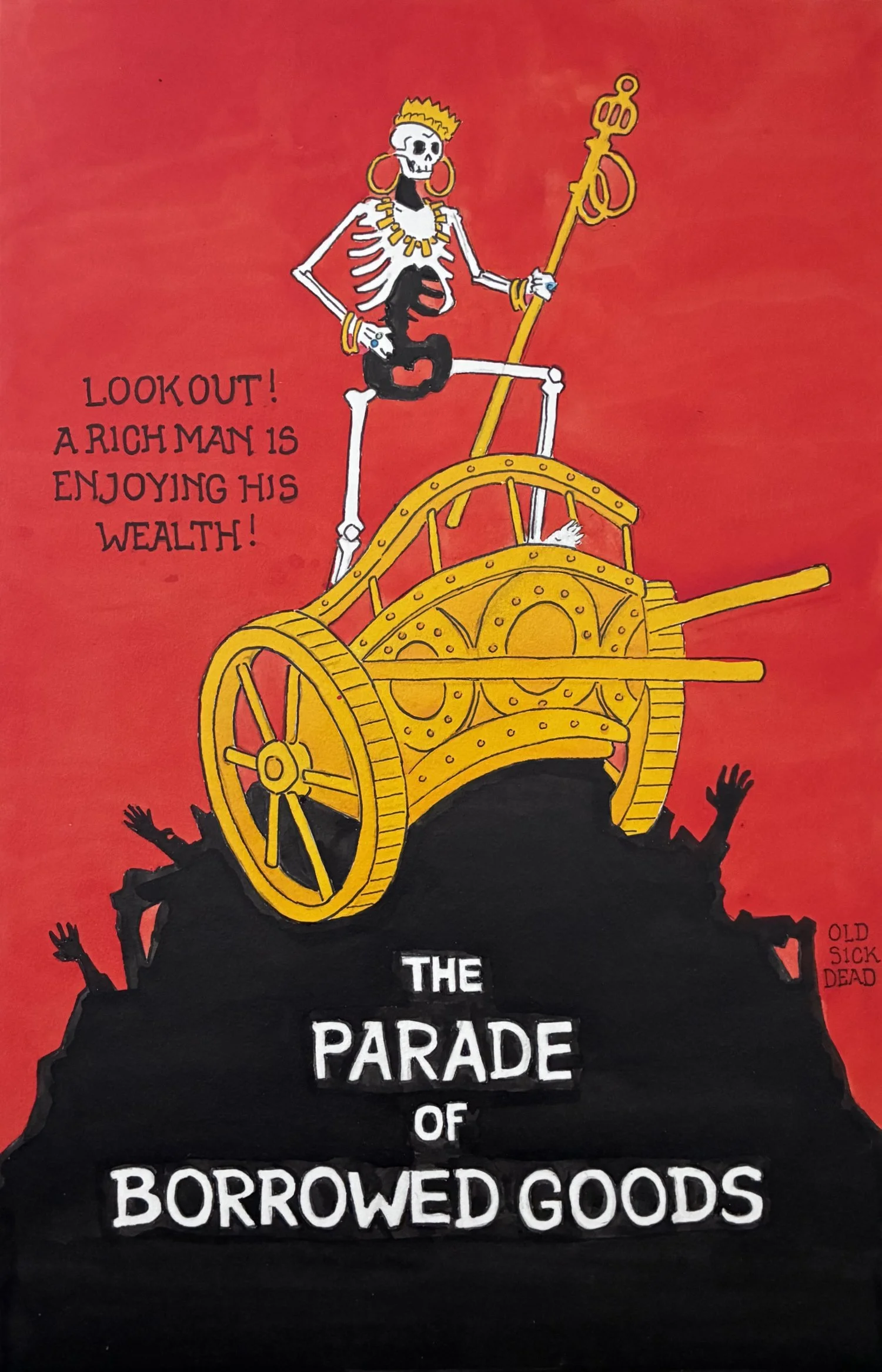
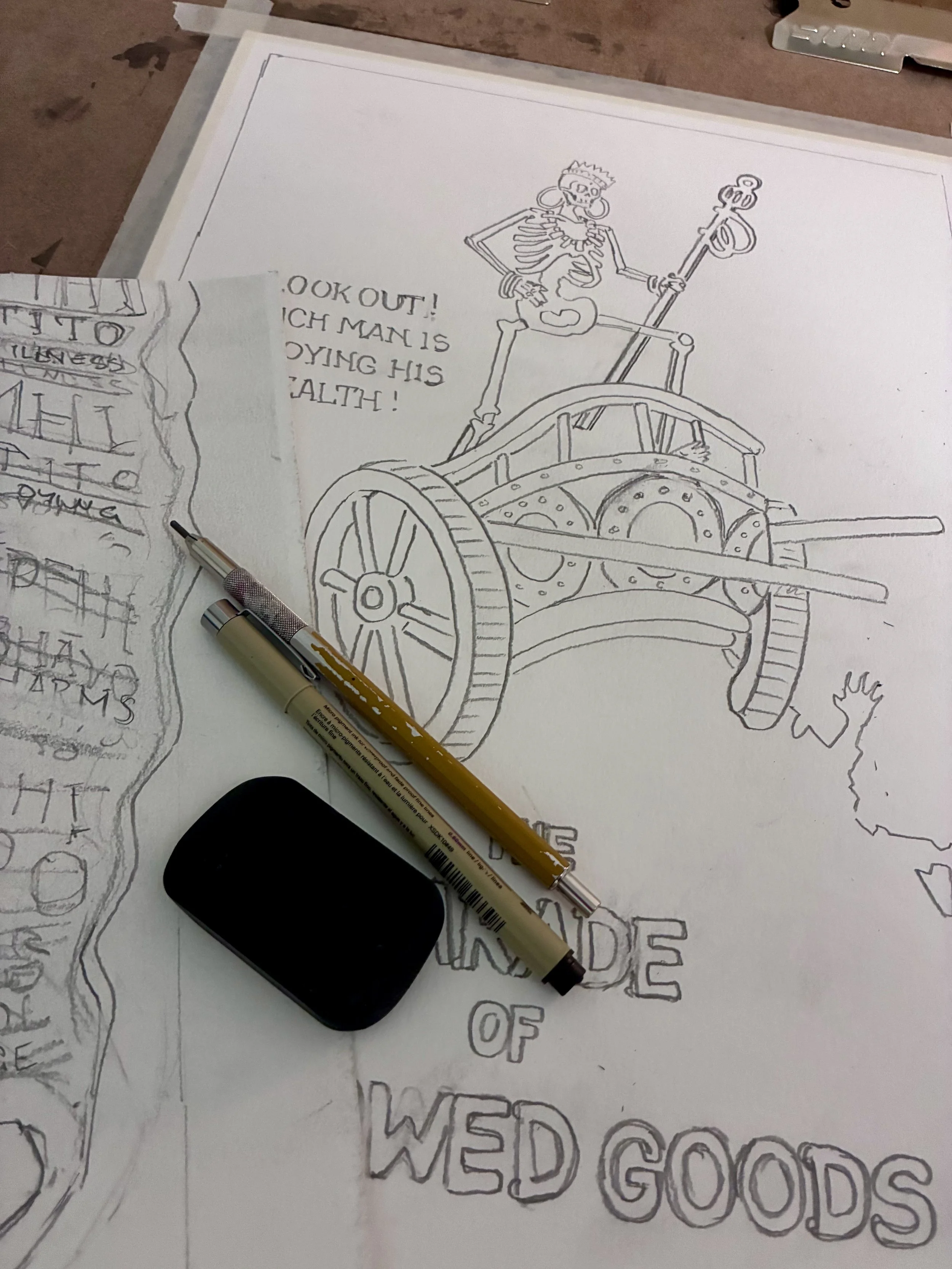
Imagine a man that has hired a luxurious chariot and fine jewelry. Adorned with those borrowed goods, he rides through the crowded downtown streets. When the people see him they say 'Look out! A rich man is enjoying his wealth!' Then there in front of everyone, the lenders see him parading those borrowed goods and strip them from him. What do you think about that? Would he be upset? - Having everything taken from him?
Sensual stimulations are like borrowed goods; they bring too much trouble and even more danger. Understanding this, one avoids the equanimity that is based on diversity and instead develops the equanimity based on unity, never taking the bait again.
'The world is not owned; we must go, leaving everything behind.'
What are you doing?
Does suicide wake you every morning and tuck you in every night? Are you tangled up so bad that you’ve been thinking about cutting yourself free?
Oh aggrieved! I know you’ve hurt. Some lovely things have gotten lost. - and it’s truly hard to see them go. It sets your jaw to see them go!
Oh aggrieved! I know you’ve hurt. Some ugly things have come along. - and it’s truly hard to endure them. It sets your jaw to endure them!
Oh aggrieved! I know you’ve hurt. We all wished for much better - and it’s truly hard to get what we get. It sets your jaw on what we get!
Your heart and mind would carry that torch until it burns you alive! You would bite down until the bitter end, but please don’t go grinding your teeth to sand!
Where to slice? What’s your hurry? Catch a breather! Try stopping for a bit. You’re like a scorched, burnt out, weary traveler on a long journey. You’d walk blindly by and never even notice this lotus pond that waits for you, right here; behind this gate-less gate. Won’t you give yourself permission to take a moment; to cool off and refresh? Your journey can wait. Set down those heavy thoughts of the past. Set down those cumbersome thoughts of the future. They’ve got you all knotted up, cut them loose! You know you’d carry it all better after you’ve quenched in the waters, chilled on the banks, and relaxed in the shade you made for yourself.
So where to slice? It hurts terribly to be so tangled up, inside and out, with a world that never stops spinning. It’s here in your practice, where the tangles get cut.
Inspired by:
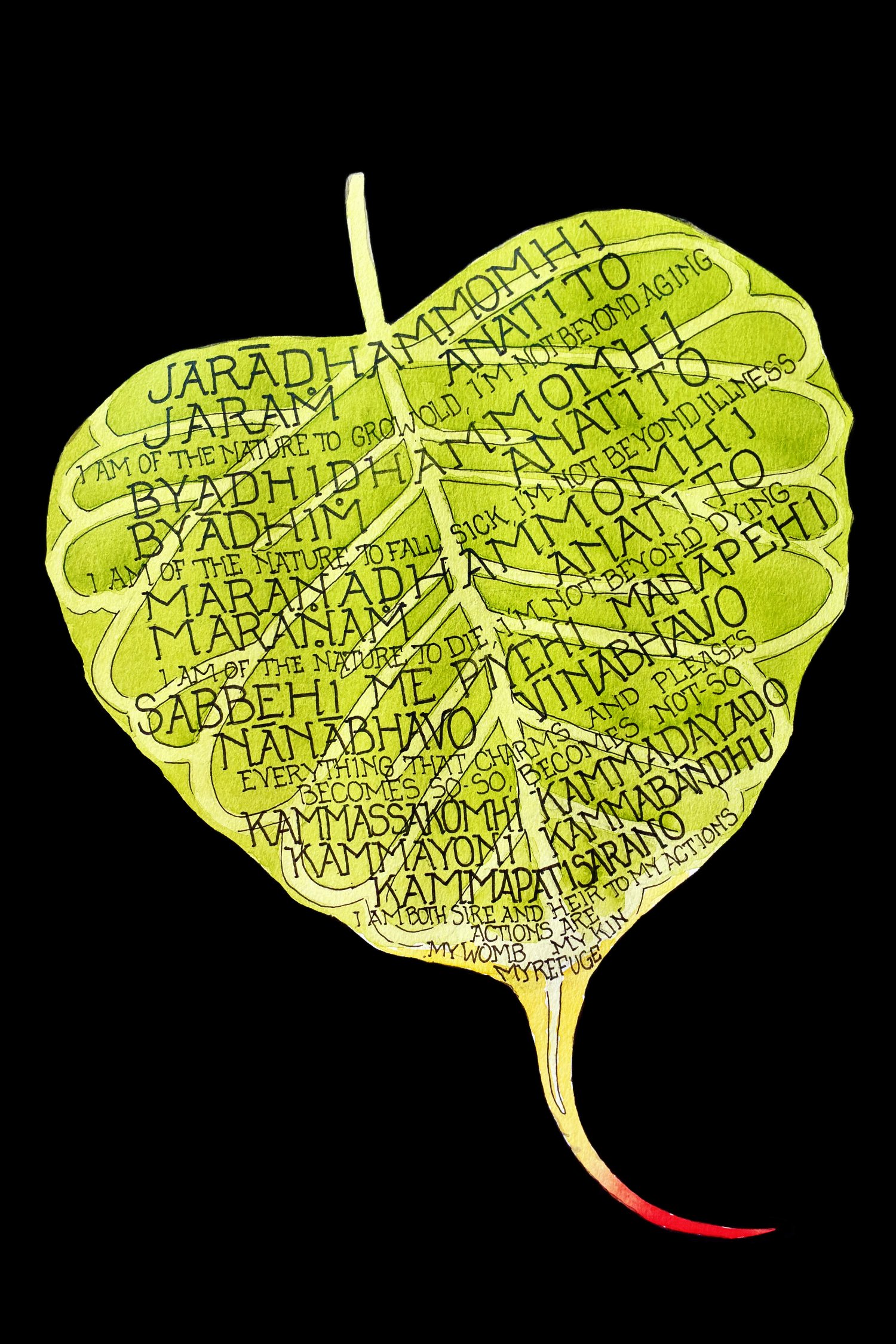
It features the five remembrances / recommended daily reflections of Buddhism written on a Bodhi Tree leaf. Please feel free to download and print for your personal use; high resolution version here: LINK.
How the Buddha taught to develop your psychic potential!

The four bases of psychic power (Iddhipādā) are Interest (Chandasamādhi), Vigor (Vīriyasamādhi), Attention (Cittasamādhi), and Investigation (Vīmaṁsāsamādhi); and they are developed simply through the practice of the noble eightfold path — that is: Right View, Right Intention, Right Speech, Right Action, Right Livelihood, Right Effort, Right Mindfulness, and Right Immersion — especially an immersion that has enthusiasm and active effort!
Think to yourself: "I’ll meditate so that my enthusiasm and active effort won’t be ‘too lax’ or ‘too tense’. I’ll be neither ‘constricted internally’ nor ‘scattered externally’. I’ll perceive ‘as before, so behind; and as behind, so before’; ‘as below, so above; and as above, so below’; and ‘as by day, so by night; and by night, so by day’. — with an ‘open and unobstructed heart, and a mind that’s full of radiance’; I’ll sit!"
So, when is enthusiasm and active effort ‘too lax’? — when it's coupled with laziness!
And when is enthusiasm and active effort to be ‘too tense’? — when it's coupled with restlessness!
What is it to be ‘constricted internally’? — when it’s coupled with dullness and drowsiness!
What is it to be ‘scattered externally’ — when it is frequently distracted and diffused externally by the five kinds of sense stimulation!
What is perceiving ‘as before, so behind; and as behind, so before’? — when the perception of before and behind is properly grasped, focused on, borne in mind, and penetrated with wisdom; it is the emptiness of causes and conditions!
What is perceiving ‘as below, so above; and as above, so below’? — when you examine your body up from the bottom of your feet and down from the top of your head, wrapped in skin and full of different kinds of filth — head hair, body hair, nails, teeth, skin, flesh, sinews, bones, marrow, kidneys, heart, liver, diaphragm, spleen, lungs, intestines, mesentery, undigested food, feces, bile, phlegm, pus, blood, sweat, fat, tears, grease, saliva, snot, synovial fluid, and urine; and see that this is not self!
What is perceiving ‘as by day, so by night; and as by night, so by day’? — when you develop the four bases of psychic power that has immersion due to enthusiasm and active effort, with the same features, attributes, and signs during the day as during the night; and during the night as during the day!
What is it to have an ‘open and unobstructed heart, and a mind that’s full of radiance’? — it’s when you have properly understood what it is to shine; and have resolved to be the day!
Now, your mind is concentrated, pure and bright, unblemished, free from defects, malleable, wieldy, steady, and attained to imperturbability, directed and inclined towards the modes of supernormal power. You exercise them!
—like a master potter with some good clay might throw any kind of pot!
—like a skilled ivory-carver with a nice piece of ivory might carve any kind of ivory item!
—Or like an artful goldsmith!
Yes! How a goldsmith holds an ‘interest’ to purify the native gold. So they pan away the coarse corruptions — washing, rinsing, and cleaning away the rock, soil, and gravel. Such is the 'interest' in separating out the coarse corruptions of unskillful conduct of body, speech, and mind.
Then with ‘vigor’ they wash it again, removing the medium corruptions of fine grit and coarse sand. And then they wash it again, removing fine corruptions of fine sand and black grime. Such is the 'vigor' to remove the middling corruptions of sensual, malicious, or cruel thoughts; and the fine corruptions of thoughts of family, country, and status.
When only golden flecks remain, the goldsmith places them in a crucible where they torch, melt, and smelt it. Applying the heat like a sustained ‘attention’ though the gold is still not settled, and the dross is not totally gone, so it’s not yet pliable, workable, or radiant. It is still brittle and not ready for working. Such is the 'attention' to fully abandon, be rid of, eliminate, and obliterate any corruptions, until only thoughts about the teaching are left — though the meditation is not yet peaceful or sublime or tranquil or unified, but is held in place by forceful suppression.
But the goldsmith keeps at it; torching, melting, and smelting it. ‘Investigating’ and testing the gold until it becomes pliable, malleable, and radiant, not brittle, and is ready to be worked. Such is the 'investigation' into when the mind becomes stilled internally; settling, unifying, and becoming immersed in Samādhi. The meditation is peaceful and sublime and tranquil and unified, not held in place by forceful suppression.
— Then like an artful goldsmith with some well-prepared gold, you might fashion any kind of gold item that you’d like!
Having been one, you can become many — and having been many, you can become one; you can materialize and dematerialize; you can go unimpeded through walls, barriers, and mountains as if through open space; you can dive in and out of the earth as if it were water — and walk on the water as if it were the earth; sitting cross-legged you can travel through space like a winged bird; so mighty and powerful — with your hand you could stroke the sun and the moon; and you can exercise mastery over your body as far as the heaven realm!
Sources:
Is There More to Choice Than Avoiding the Burning Pit?
“Your choices, aims, and intentions incline to get far away from that hell!”
Full artwork and reflection →

Suppose there was a deep burning pit full of red hot coals, and two villains were to grab you by the arms and drag you towards the edge to throw you in.
And you being a person who wants to live and doesn’t want to die, who likes being happy and doesn’t like pain — your choices, aims, and intentions incline to get far away from that hell! Because you know if you fall into that burning pit, it would kill you or make you wish you were dead!
When the nutriment of mental volition is fully realized, with its three kinds of cravings — tilting to delight and relish in sense pleasure, inclining for 'this' to be, and leaning for 'that' not to be! — then there is nothing further to be done with it.
The same movements that nourishingly bring you into balance when taken too far can also pull you into a tragic continuous lean. The same instincts that keep you alive and out of pain, when clung to send you into the pit. It’s one thing to escape all painful hells and another to be diving after all wishes of heavens. Somewhere in between is the middle way, and the restraint to find your balance and your equanimity.

Were You Conscious Of The Overkill?

Suppose there is a bandit, a criminal under arrest. They take him in the morning before the king and say: ‘Punish him as you will!’
The king says: ‘Strike the man this morning with a hundred spears!’
— and they do it.
Then at midday the king says: ‘How is that man? If he’s still alive, strike him this mid-day with a hundred spears!’
— and they do it.
Then late in the afternoon the king says: ‘How is that man? If he’s still alive, strike him this late afternoon with a hundred spears!’
— and they do it.
What do you think? Would that man experience pain and distress from being struck with three hundred spears a day, let alone one spear?
It’s the same way for the nourishing consciousness of name and form, like the striking of a spear can become the overkill of three hundred spears.
When the nutriment of consciousness is fully realized, as a strike of name and form! — then, there is nothing further to be done with it.
“Light comes; light strikes.
Darkness comes; darkness strikes.
All directions come; the whirlwind strikes.
Nowhere comes; the one-piece stance strikes.”
(Fuke Zenji, preserved in The Complete Book of the Five Lanterns; translated by OSD)
Consciousness is a nutriment, that is to say it’s necessary in order for us to find nourishment. Knowing the name and form, being aware of a thing - is required for us to be aware if it nourishes or it doesn’t.
And to become aware of something is to both know its form (shape, physicality) and its name (information, codification). But beyond that is the over application of this consciousness, driving definition into something over and over again, like the overkill of three hundred spears.
What does three hundred spears do that one does not? If the criminal is defined ‘a bandit’ 100 times in the morning, 100 times mid-day, and 100 times in the evening; when can he change? When can he reform? When can he grow?
So restraint of the consciousness is a compassion, rather than an overkill of persistent definitions and fixed views.

Pestered like a Flayed Cow!

Suppose there is a freshly flayed cow —
If she’s set exposed to a wall, the creatures that dwell in the wall will nibble at her!
If she’s set exposed to a tree, the creatures that dwell in the tree will nibble at her!
If she’s set exposed to the water, the creatures that dwell in the water will nibble at her!
If she’s set exposed to the open air, the creatures that dwell in the open air will nibble at her!
Whatever that flayed cow stands exposed to, the creatures there will nibble at her!
It’s the same way for the nourishing contact of the senses. No matter where they’re set, exposed senses are pestered like a flayed cow!
When the nutriment of contact is fully realized, with its three kinds of feelings—pestered with itching for the pleasing, swatting at the suffering, and shooing the neutral! — then, there is nothing further to be done with it.
Sensory contact and input is necessary—finding what’s nourishing requires the discernment of what’s good, bad, or neutral. But it’s best for it to be seen as a fuel and not an invitation to overindulge or overexpose the senses. Because like a flayed cow, the senses will be pestered no matter where they are placed.
A Torii gate, like a Torana, are honorific gateways that invite the attention and engagement of the senses — to the spirit of the place, or the sacred space, or the beauty framed. So in hanging a flayed cow there it illustrates the sutta and the ‘contact’ the structure requests.
It’s common to imagine that further stimulation of the senses is what we need to relax, like seeking entertainments. But the engagement of the senses is always just the ‘exposure’ of our sight, hearing, smell, taste, touch, and mind — to discerning whether things are good, bad, or neutral. So relaxation is really found through a practice of seclusion and sense restraint, the guarding of the senses. 🐄
Sources:

No Mud, No Lotus!

The lotus flower is a beloved symbol of non-attachment because even though it sprouts in the mud, grows in the water, and blossoms in the mist and rain - there are no drops on the lotus! Scientifically it’s called the ultra-hydrophobic effect; whereby on a molecular level the plant has let go of the water. It beads up and rolls off.
We are like the lotus: born into suffering, grown up through suffering, and face suffering every day! - and we too can let it bead up and roll off! Freedom is in the release and letting go! Transcend all your suffering, and give thanks to it as you say goodbye! — because like the Zen Master Thich Nhat Hanh said; ‘No Mud, No Lotus’!
Sources:


Co-Arising!

(18”x 24”, Acrylic Paint on Canvas)
This tessellation is a field of “Spectres”; strictly chiral aperiodic monotiles. A shape that was only recently discovered by mathematicians in 2023; they are one-sided asymmetric tiles that can completely cover a plane in an irregular pattern that never repeats. The only symmetry it exhibits looks to me like the Buddha, sitting meditatively in a sea of interconnected and endlessly unfolding percolation, a co-arising dependent on causes and conditions (paṭiccasamuppāda).
This body is not yours, nor anyone else’s.
It is old action—deliberately chosen, intentionally decided—to be experienced; it should be seen in that way.
One who listens to the liberated carefully and wisely attends to dependent arising itself, thinking:
When this is, that is; with the arising of this, that arises; when this is not, that is not; with the cessation of this, that ceases.
Ignorance is the condition for choices; choices are the condition for consciousness … and so on … thus the arising of this whole mass of suffering comes to be.
But with the complete fading away and cessation of ignorance comes the cessation of choices; with the cessation of choices, the cessation of consciousness … and so on … thus the cessation of this whole mass of suffering comes to be.
Sources:
